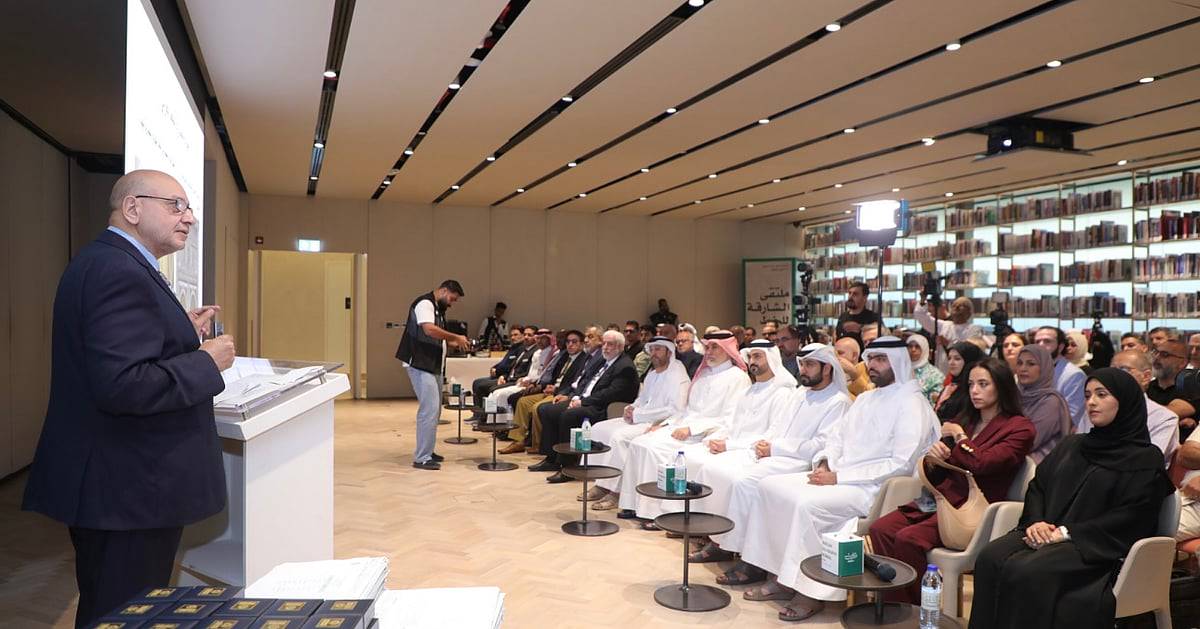
The 12th edition of the Sharjah Calligraphy Biennale opened on Friday at the House of Wisdom in Sharjah, drawing researchers, artists, calligraphers and media figures from across the region to examine the cultural and aesthetic dimensions of Arabic script.
This year's accompanying symposium carried the title "Arabic Calligraphy: Between Authenticity and Global Leadership," a framing that pushed the conversation beyond calligraphy as a writing practice and into its presence in literature, architecture and contemporary art. Speakers used the session to argue that Arabic script can simultaneously safeguard the visual identity of the Arab world and hold its own on the international art stage.
Dr Khaled Azab, one of the symposium's speakers, focused on how Arabic calligraphy has shaped visual identity and reinforced the distinctive character of Islamic architecture over the centuries. He described how the script moved beyond a purely functional writing tool to become a decorative and meaning-carrying element woven into Islamic buildings and monuments.
Dr Khalil Gouiaa addressed the evolution of the art form itself, describing it as a shift "from a linguistic tool into an artistic element possessing aesthetic and expressive dimensions." He said this transformation shows that Arabic script today, beyond its communicative role, plays an independent part in the region's visual arts and collective cultural memory.
The symposium closed with recognition given to a number of researchers, artists and calligraphers who have contributed over recent years to promoting the cultural standing of Arabic calligraphy. The Sharjah Calligraphy Biennale is a fixture on the UAE's cultural calendar, each edition bringing together established calligraphers with a newer generation of artists working in the script.