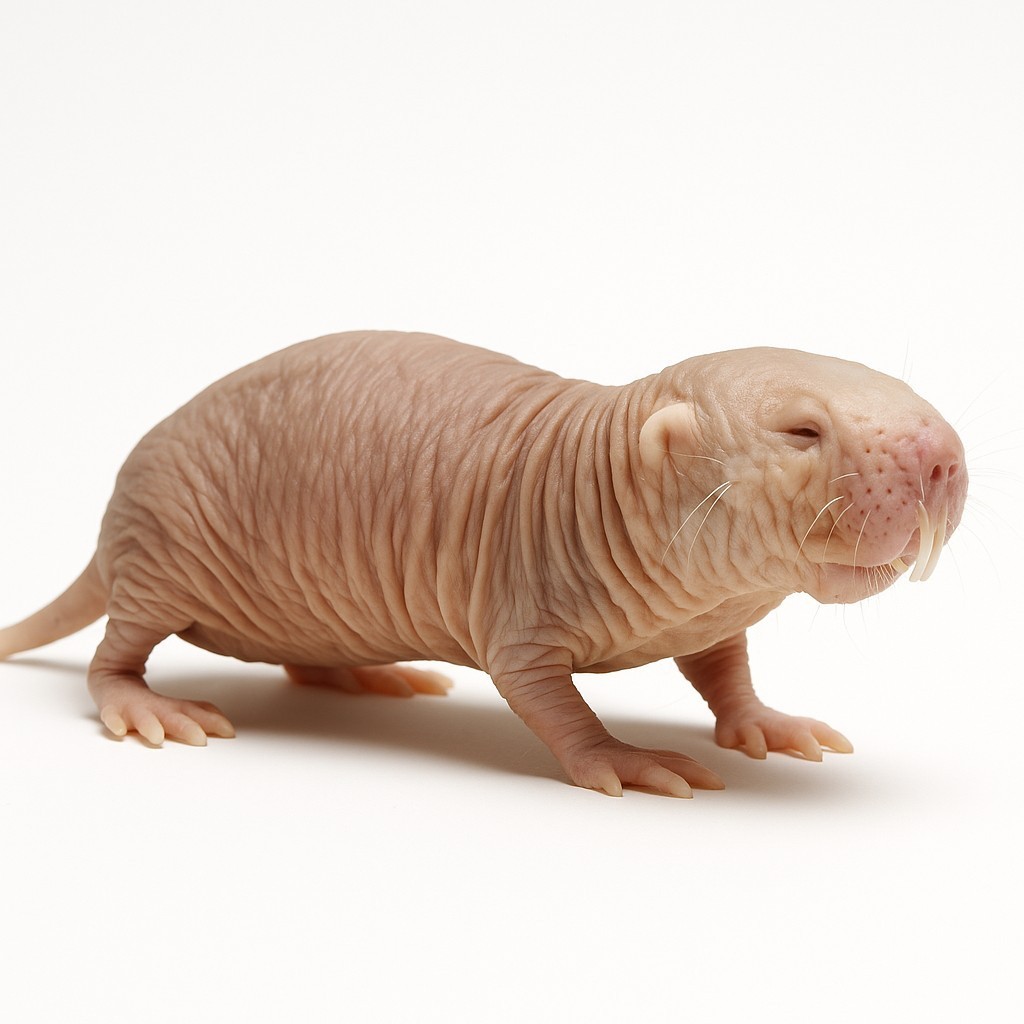
🧬 Discovery of the Secret to the Extraordinary Lifespan of Naked Mole Rats in Shanghai
“A Protein That Could Unlock the Gateway to Biological Immortality”
In one of the most exciting biological discoveries of recent years, scientists from Tongji University in Shanghai have unveiled the genetic secret behind the astonishing lifespan of the naked mole rat—a small, hairless, underground creature that can live up to 40 years, while most rodents survive only a few years.
This research, the results of which have been published in the prestigious journal Science, reveals that the main secret lies in the way a protein called c-GAS functions; a molecule that typically disrupts DNA repair in humans, increasing the risk of cancer and cellular aging. However, in the naked mole rat, this same protein has astonishingly reversed its function—rather than causing damage, it now accelerates and enhances repair.
🧫 Evolutionary Rearrangement of a Protein
Chinese researchers, by examining the molecular structure of this protein, found that its appearance is similar to the human version, but several key connections in its internal structure have been rearranged. This small change has resulted in c-GAS functioning entirely differently in the naked mole rat, acting as a natural catalyst for DNA reconstruction instead of causing inflammation or disrupting repair. a professor at the University of Cambridge and a DNA repair specialist:
> “One can think of c-GAS as a piece of a biological puzzle. Its human version causes cellular wear and tear, but the naked mole rat version has redefined that structure with fresh wiring internally; it’s as if nature has rewritten the molecular law of aging in this creature.”
🧠 Resistance to Disease and the Passage of Time
The result of this genetic rewriting is a body that almost defies the laws of cellular death. Naked mole rats are resistant to cancer, Alzheimer’s, arthritis, and neural tissue degeneration. Their cells maintain high repair capabilities even in old age, and their DNA remains remarkably stable.
Dr. Zhang Wei, the head of the research team at Tongji University, stated:
> “We are investigating the molecular version of long life. This change in c-GAS function may provide a blueprint for reconstructing the genetic repair system in humans.”
🌍 A Step Towards Engineering Immortality
Scientists believe that if the biological mechanisms of this creature can be reverse-engineered, it may one day be possible to activate the same repair pathways in the human body—pathways that could slow the aging process and multiply cellular lifespan.
According to Balmus:
> “This research is not just about one rat; it’s about redefining the future of human biology. Perhaps the naked mole rat is the first living blueprint that tells us immortality is not just a dream, but a subject of study and perhaps even a construct.”
📚 The Open End of Science
While there are still years to go before practical applications of these findings are realized, the path is clear. Evolution, in the darkness of underground tunnels, has nurtured a creature that has inscribed the secret of longevity within itself. And perhaps, just as this small rat has rewritten the code of gene repair, humanity too will one day redesign its molecular version of long life—not through dreams, but through science.