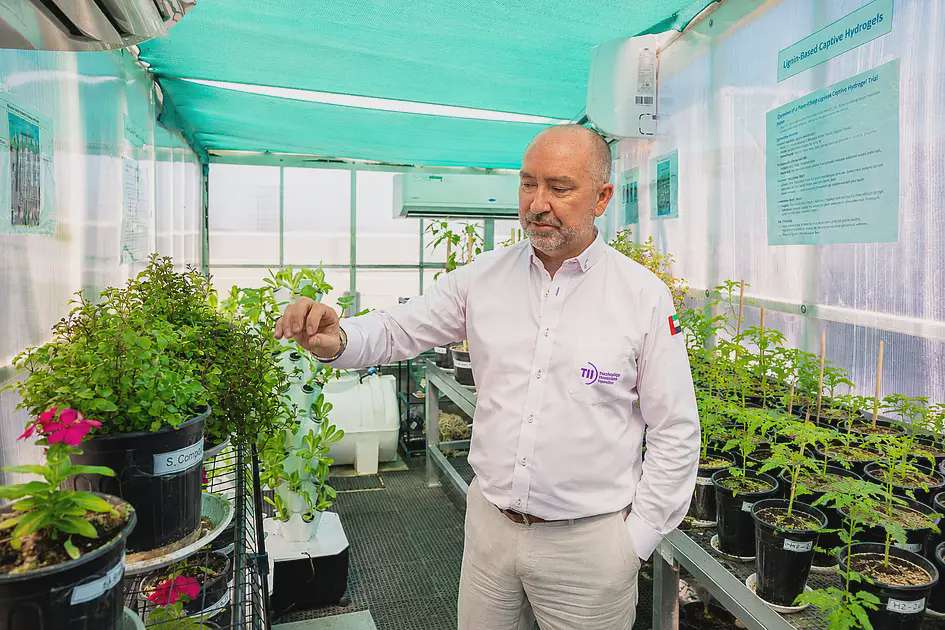
Researchers at the UAE's Technology Innovation Institute (TII) have developed a gel made from plant waste, including date palm residue, that can cut agricultural irrigation water use by around 30 percent. The project is led by Professor Phil Hart, Chief Researcher and Head of TII's Renewable and Sustainable Energy Research Centre.
The material, called an agrigel, is produced by processing plant waste into a porous substance that is then blended with other components before being mixed into soil. Each particle of the gel acts as a miniature, independent water reservoir: it absorbs moisture quickly and releases it gradually as the plant needs it. Part of the formulation also includes fertiliser components that break down over the growing season, feeding nutrients to the plant gradually and potentially cutting the need for separate fertiliser applications.
In greenhouse trials, the gel delivered roughly a 30 percent reduction in irrigation requirements. Spinach grown with the gel reached about twice the size of untreated plants, while corn treated with the material grew to roughly double the length of the control group.
"More crops, less water" is how Prof Hart summed up the project's goal. The gel is now being tested in field trials at three sites — Al Ain, an area north of Yas Island, and Al Barsha — with commercialisation targeted for 2027.
In a parallel project, the TII team has used artificial intelligence to screen 40,000 chemical combinations for molecules that protect against ultraviolet radiation, identifying 10 promising candidates for use in solar panels — a step that could help extend the lifespan of solar equipment in the region's harsh climate.