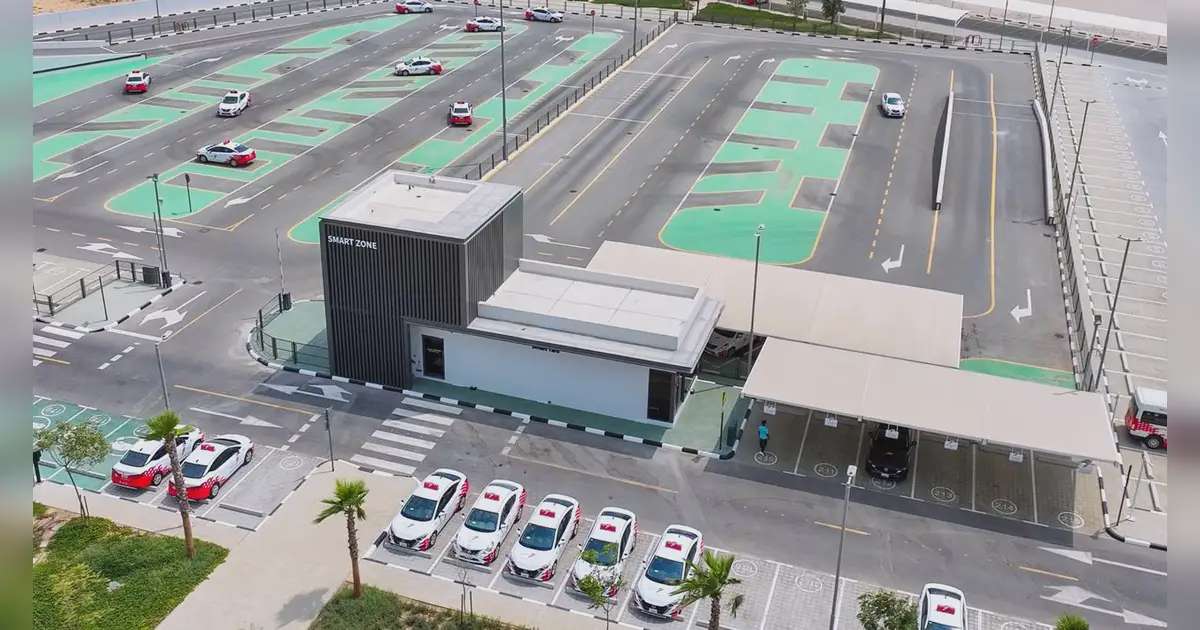
Dubai's Roads and Transport Authority (RTA) has rolled out a next-generation testing platform for light-vehicle yard tests that uses artificial intelligence and computer vision to assess candidates objectively, replacing the manual scoring previously carried out by human examiners.
Under the new system, smart cameras track a candidate's behaviour throughout the test, monitoring mirror checks, awareness of blind spots and hand positioning on the wheel. A facial recognition system verifies the candidate's identity to prevent impersonation during testing. Real-Time Kinematic positioning technology tracks the vehicle's exact location on the course to within roughly two centimetres, while an automatic braking feature intervenes if the system detects a collision risk.
One of the platform's key features is an interactive 3D map that displays the test route alongside the precise locations of any errors made. Sultan Al Akraf, RTA's licensing director, said the system provides an integrated framework for monitoring and analysing learner performance across different manoeuvres, presenting mistakes in a clear, visual format rather than a simple pass-fail score.
After the test, candidates can replay their route to see exactly where and why they lost points, making it easier to identify specific skills that need improvement before retaking the test. The system performs consistently across varying weather and lighting conditions, which RTA officials say makes evaluations more accurate and fairer than the traditional, examiner-dependent process.