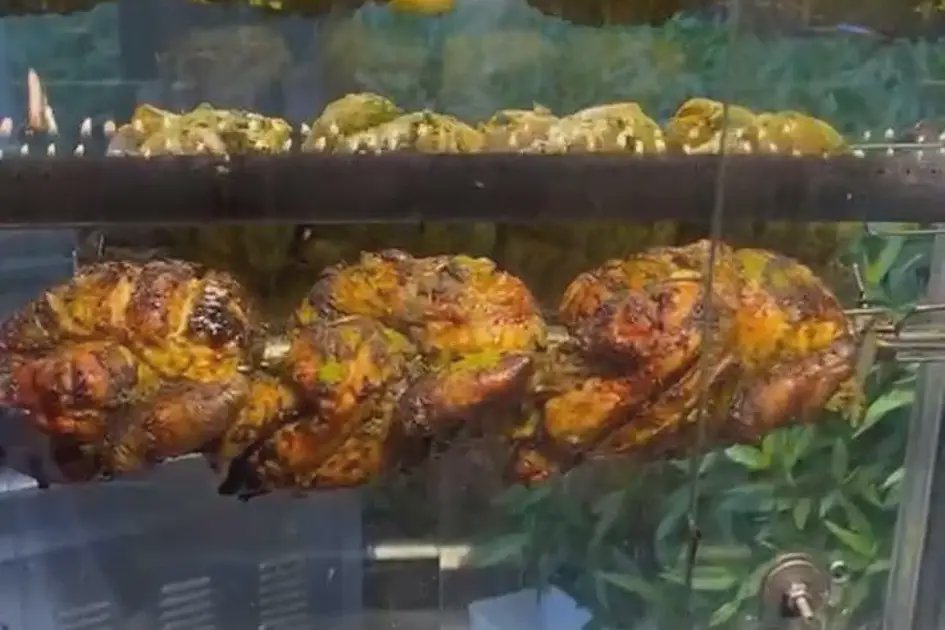
A UAE food safety expert has warned against a common practice at some cafeterias and small restaurants: collecting the liquid that drips from rotisserie chicken machines and serving it to customers as gravy.
Bobby Krishna, a food safety specialist, told Khaleej Times that this liquid is essentially raw chicken juice, not a sauce prepared in the kitchen. He said the practice carries a genuine risk of food poisoning, since drippings from raw or partially cooked chicken can carry harmful bacteria.
Krishna flagged two further risks in the same machines. The first is improper placement, with raw chicken loaded onto upper racks directly above cooked chicken, allowing juices from the raw birds to drip onto food that is ready to serve. The second is the practice of selling half a grilled chicken while the other half remains inside the machine, which exposes the cooked half to drippings from the raw chicken still roasting nearby.
His recommendations for outlets are straightforward: any accompanying sauce should be prepared separately in the kitchen rather than scooped from the base of the rotisserie machine; raw and cooked chicken must be stored and displayed in fully separate areas; basting sauce, if used, should be kept outside the machine; chicken should be arranged so raw birds cannot drip onto cooked ones; and cooked chicken should be held at a minimum of 63°C until served.
The warning is particularly relevant for residents and visitors who routinely eat grilled cafeteria chicken with the liquid served alongside it as a dip — a habit that, according to Krishna, can be made considerably safer simply by following these basic kitchen practices.